
The Lund University Case Academy (LUCA) was founded in 2012 by faculty members at Lund University as a cross-faculty network to promote case-based and student-centered learning. This year’s event was held in April at the Lund University School of Economics and Management, focusing on a central theme: how to construct effective cases. The day began by exploring how well-designed cases can serve as powerful tools for learning, reflection, and deeper understanding. By combining theory with real-world situations, the conditions for active participation in the classroom are created.
The art of storytelling brings cases to life
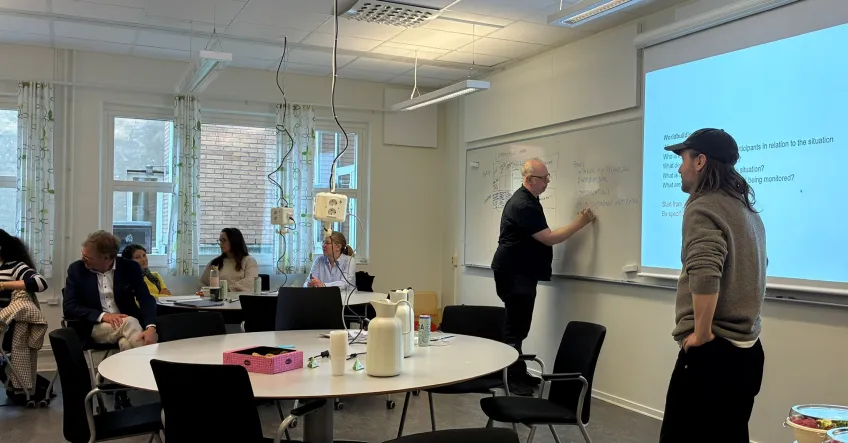
One of the highlights was a workshop led by Jörgen Dahlqvist and Martin Bengtsson from Malmö Theatre Academy. They demonstrated how principles from dramaturgy and storytelling can be used to build engaging case studies. By working with narrative structure and dramaturgical techniques, case studies can come to life and spark students’ curiosity and engagement.
When students create their own case studies
William Bengtsson, a student in the Corporate Brand Management and Reputation course, presented the course structure alongside course director Mats Urde, in which students develop and write their own case studies. Constructing their own case studies was highlighted as a powerful pedagogical tool. By formulating problems, context, and perspectives, students not only deepen their understanding of the subject but also develop their creativity and analytical skills.
Start small and experiment. Talk to the students, ask for feedback, and refine as you go
Getting Started with Cases
One of the organisers behind LU Case Day is Nadja Sörgärde, a senior lecturer at LUSEM and a dedicated advocate for case-based learning. When asked how teachers can get started with cases, her advice is clear:
– Start small and experiment. Talk to the students, ask for feedback, and refine as you go.
Nadja also emphasizes the importance of distinguishing between different types of cases, depending on the purpose and teaching situation.
Different types of cases
The type of case that works best depends on what you want students to take away from the experience. Some cases are primarily designed to help students understand and remember. These so-called illustrative cases are often relatable, streamlined, and built around a clear narrative that makes them easy to remember.
Other cases focus on training the ability to apply theory in practice, so-called concept-application cases. These cases are usually more structured, yet contain enough nuances to challenge students to apply their knowledge.
When the goal is instead to develop students’ analytical skills, problem-formulating cases are used. Here, the focus is on identifying and understanding complex problems, often without an obvious correct answer.
In the most active form, decision-making cases, students themselves step into the role of decision-makers. They must weigh different perspectives and make decisions despite limited information, just as in real life.
What characterizes a good case?
Regardless of type, there are some common characteristics of effective cases:
• They contain just the right amount of incomplete information.
• They revolve around a clear problem or decision.
• They can be interpreted and solved in multiple ways.
• They are realistic and relatable.
• They connect to the course’s learning objectives.
• They are written as engaging stories.
According to Nadja Sörgärde, the most effective cases are often based on real-life events. At the same time, this is also the biggest challenge: capturing the complexity without making the material too extensive or fragmented.
What makes case-based learning so powerful, according to Nadja, is its ability to engage:
– When students want to understand and solve a problem, they also start having real discussions. I want strong student engagement when we meet in the classroom – and that’s where cases are essential.