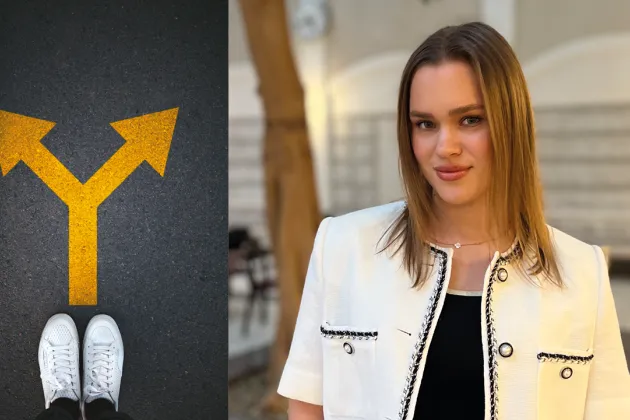

Emma Jacobi is studying the international Bachelor’s programme Economy and Society, which is taught entirely in English. For Emma, who grew up in the US, this is an advantage.
“I have Swedish parents but grew up in California,” says Emma. “We speak Swedish at home, but I’ve always studied in English and that was something I wanted to continue doing. When it was time to apply for university I decided to move to Sweden to build my own network here. Being able to study in English in a Swedish environment suits me perfectly!”
Attracted by LUSEM and the student life
“I knew I wanted to study something related to business and economics, and when I compared different universities in Sweden, I settled on Lund University,” says Emma. “I’d never been to Lund before, but I was drawn to both the programmes at LUSEM and Lund’s vibrant student life.
In Economy and Society, you get a broad education grounded in economic history, which Emma appreciates:
“I like the mix of economics and society; it gives you a more intersectional understanding of economics and its background.”
It’s one of the best things about an international education; you get the chance to make new friends from different countries and cultures.
Studying an international programme with both students and lecturers from all over the world are key strengths of the programme, says Emma.
“For example, I’m now going to write my dissertation together with a girl from Estonia,” says Emma. “I think it adds something extra that we have such different backgrounds and starting points. It’s one of the best things about an international education; you get the chance to make new friends from different countries and cultures.”
Another thing Emma wants to highlight is the teachers at the programme. She explains:
“Our teachers are incredibly knowledgeable and regularly conduct research in their fields. They’re also very committed to the students, and you can tell they want you to succeed. I think all of this creates a very inspiring study environment.”
Community across programmes
“When I moved to Lund, I didn’t know anyone here, but student life has really given me the chance to find lots of different social circles,” says Emma. “Everyone is new in some way, and most have moved here to study in Lund. I like the culture where you can meet up spontaneously and have a coffee or dinner without it having to be anything fancy.”
Emma is a reporter for the student union LundaEkonomerna’s own magazine for and by students, Nådiga Lundtan.
“I’ve been writing for Nådiga Lundtan for almost a year now and it’s a really great role,” says Emma. “We’re given topics to write about and it’s so exciting to read everyone’s interpretations of the subjects we’ve been assigned.”
Emma appreciates the sense of community at LUSEM, not least thanks to LundaEkonomerna. She explains:
“There’s a sense of community that extends across programme boundaries, which means you have the opportunity to socialise with students studying different subjects to yourself and who have different perspectives.”
Advice for future students
As you begin your studies at university, a lot is new, not least the fact that there’s a higher proportion of self-study than in upper secondary education. Emma’s advice to new students is to spend time early on establishing a good structure for your studies.
“Finding your own structure so that you stay on track with the lectures makes life as a student easier,” she explains. “You undertake a course to learn about a subject, not just to pass the next exam. My advice is to think about how you learn best and to establish good routines for how and when you should study.”
What am I passionate about? Does this subject inspire me? Does it give me that ‘wow’ feeling?
When choosing a course, Emma believes the most important thing is to have a passion for the subject. She suggests thinking about what will feel inspiring even in the future:
“Ask yourself: What am I passionate about? Does this subject inspire me? Does it give me that ‘wow’ feeling? Be honest with yourself and think about whether it’s something you want to pursue in the future.”
When asked what Emma wants to work with in the future, she highlights her interest in writing and her curiosity about career paths in marketing.
“After my Bachelor’s degree, I want to do something fun that really inspires me to keep developing, so I want to continue studying and do a Master’s,” says Emma. “I love writing and am very curious about working in marketing, so I’m looking forward to finding a creative career in the business field.”